
A Sussex trug is a wooden basket, crafted with a unique steaming and bending technique that dates back centuries. Its construction is often compared with a coracle, or a clinker built boat, with its overlapping boards. They are deceptively lightweight but strong, and beautifully practical and are used by gardeners, growers, and households across Britain for generations. It is said, you are not a gardener if you don't have a trug and consistently features in TV gardening and cooking programmes.
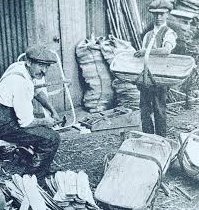
Many trugs that are over 100 years old have been handed-down as heirlooms, not of great monetary value, but a have a high value in historical family member remembrance. They truly make the most perfect gift for a gardening enthusiast, even if they have one, a different size is invaluable.
The Sussex trug has deep roots in the Wealden landscape. Its origins stretch back to the 1500s, when local craftspeople began shaping coppiced wood into lightweight, durable baskets for farming and household use. The craft became famous in 1851 when Queen Victoria purchased trugs at the Great Exhibition. From that moment, Sussex trugs became a symbol of British craftsmanship. In the distant past, there were literally hundreds of Trug makers, but today, only a handful of workshops continue the making. Yet another demise of an ancient craft.
Trugs are traditionally made from sweet chestnut and willow, but in 1970 the company I worked for as a traditional trug maker, could no longer source the material. Rather than cease production, we experimented with alternative material - Birch. We found that it was stronger, resisted woodworm that is caviar to the pest, and less prone to rotting. When the old material became available again, we decided to continue using Birch as it was such a great success. It was at this time the 'Harlequin Trug' was born.
The frame (handle and rim) of the trug is steamed for 20 - 40 minutes (seasonal workshop temperature dependant) before bending and shaping around formers to form their iconic shape. When dry, both are nailed together with galvanised rust resistant nails. The boards are then shaped in various widths, the widest forming the bottom board, the following six boards progressively narrowing. All boards are similarly steamed before the trug assembly using solid copper nails and fitting the feet .
Every trug is checked by the maker (me, the oldest living continuing maker), satisfied that the trug is without fault, I sign and date the trug on the baseboard underneath. As I understand by sellers at antiques fairs, this actually makes my trugs collectible. (Antique!!!! what a nerve!).
Before sending out the trug, my wife Jaqui PhD (Packing and Handling Department) checks a second time before stamping with our Sussex Trug stamp.
'Trug makers' make four different sizes, 5-6-7 and 8 as I have found the four will cover every use or application. Other makers, I know make a larger range of sizes, but as I understand, those above and below are the least popular.
Size |
|
No.5 | Berries, hand-tools, light picking, Kitchen container for eggs, herbs etc. Daddies little helper. |
No.6 | Everyday gardening as a tool carrier, smaller harvesting. |
No.7 | The general purpose gardening tool, the most popular and the choice of many. |
No.8 | Heavier harvesting, weeding, for the allotment owner, logs. Chosen by Monty. |
Daffodil | Long stemmed flower picking, foraging, to prevent crushing when collecting soft fruit and berries. |
A well‑cared‑for trug can last a lifetime. With normal use, your trug will develop a beautiful patina over time.
DO NOT store your trug in a greenhouse, during sunny days the temperature will dry out the trug losing its natural moisture content, which will make it brittle and more prone to a fracture. I compare this to a fresh branch/twig on a living tree that will bend and return to its original shape, but after dropping to the ground and drying, it loses all flexibility.
After use, don't hesitate to hose it down or dunk it into water to clean, like a dog it will love it!
Every trug from 'Trug Makers' is crafted by Kevin, at 75 the longest‑practising trugmaker in Sussex. With decades of experience, Kevin continues the heritage craft ensuring each trug is built with care, precision, and most of all, pride.
Why are his trugs so much cheaper than others? In his own words, " That's easy to answer! Firstly, I enjoy working hard, looking forward so much to every day. I employ no-one, so no commitment to cover their wages. It also avoids training them in the art of trug making, then leave to become competitive business. I have tried, but they do not seem to have a true love of the art, more interested in their iPhone. Secondly, I refuse to supply the trade, as they expect a 50% discount, and many eventually pay their bill the next time Haley's comet reappears. This also means I don't have to inflate my retail prices to allow for trade discount, so I'm able to offer my customers a fair price.
I go to work when I wake and go home if I'm tired. If it's a sunny day, I can just shut the workshop and sit on my decking at home with a glass (or two) with Jaqui PhD (Packing and handling Dept.) and no apprentice to worry about".
Kevin Skinner is one of the few remaining trug makers but you won't typically find his trugs in large chain garden centers, but here is exactly where you can get one:
1. Directly from the Maker (His Official Website)
The Benefit: You get the most competitive pricing because there is no ‘middleman’.
Personal Touch: Kevin signs and dates every single trug on the bottom board, making it a genuine collector's piece.
Custom Orders: You can order various sizes (No. 5 through No. 8) and specialized designs like the Harlequin or Daffodil Trug.
2. Visit the Workshop (Hailsham, East Sussex)
If you are local or fancy a trip, you can visit the workshop:
Location: Unit 3, 42A Mill Road, Hailsham, BN27 2HT.
Note: It’s always best to call ahead (01323 440452) to make sure Kevin is there.

A complete Guide to Sussex Trugs

A Sussex trug is a wooden basket, crafted with a unique steaming and bending technique that dates back centuries. Its construction is often compared with a coracle, or a clinker built boat, with its overlapping boards. They are deceptively lightweight but strong, and beautifully practical and are used by gardeners, growers, and households across Britain for generations. It is said, you are not a gardener if you don't have a trug and consistently features in TV gardening and cooking programmes.
Many trugs that are over 100 years old have been handed-down as heirlooms, not of great monetary value, but a have a high value in historical family member remembrance. They truly make the most perfect gift for a gardening enthusiast, even if they have one, a different size is invaluable.
The Sussex trug has deep roots in the Wealden landscape. Its origins stretch back to the 1500s, when local craftspeople began shaping coppiced wood into lightweight, durable baskets for farming and household use. The craft became famous in 1851 when Queen Victoria purchased trugs at the Great Exhibition. From that moment, Sussex trugs became a symbol of British craftsmanship. In the distant past, there were literally hundreds of Trug makers, but today, only a handful of workshops continue the making. Yet another demise of an ancient craft.
Trugs are traditionally made from sweet chestnut and willow, but in 1970 the company I worked for as a traditional trug maker, could no longer source the material. Rather than cease production, we experimented with alternative material - Birch. We found that it was stronger, resisted woodworm that is caviar to the pest, and less prone to rotting. When the old material became available again, we decided to continue using Birch as it was such a great success. It was at this time the 'Harlequin Trug' was born.
The frame (handle and rim) of the trug is steamed for 20 - 40 minutes (seasonal workshop temperature dependant) before bending and shaping around formers to form their iconic shape. When dry, both are nailed together with galvanised rust resistant nails. The boards are then shaped in various widths, the widest forming the bottom board, the following six boards progressively narrowing. All boards are similarly steamed before the trug assembly using solid copper nails and fitting the feet .
Every trug is checked by the maker (me, the oldest living continuing maker), satisfied that the trug is without fault, I sign and date the trug on the baseboard underneath. As I understand by sellers at antiques fairs, this actually makes my trugs collectible. (Antique!!!! what a nerve!).
Before sending out the trug, my wife Jaqui PhD (Packing and Handling Department) checks a second time before stamping with our Sussex Trug stamp.
'Trug makers' make four different sizes, 5 - 6 - 7 - 8 I believe these sizes cover every use or application. Other makers, offer a larger range of sizes, but as I understand, those sizes above and below my range are the least popular.
Size |
|
No.5 | Berries, hand-tools, light picking, Kitchen container for eggs, herbs etc. |
No.6 | Everyday gardening as a tool carrier, smaller harvesting.
|
No.7 | The general purpose gardening tool, the most popular and the choice of many.
|
No.8 | Heavier harvesting, weeding, for the allotment owner, logs. Chosen by Monty.
|
Daffodil | Long stemmed flower picking, foraging, to prevent crushing when collecting soft fruit and berries. |
A well‑cared‑for trug can last a lifetime. With normal use, your trug will develop a beautiful patina over time.
DO NOT store your trug in a greenhouse, during sunny days the temperature will dry out the trug losing its natural moisture content, which will make it brittle and more prone to a fracture. I compare this to a fresh branch/twig on a living tree that will bend and return to its original shape, but after dropping to the ground and drying, it loses all flexibility.
After use, don't hesitate to hose it down or dunk it into water to clean, like a dog it will love it!
Every trug from 'Trug Makers' is crafted by Kevin, at 75 the longest‑practising trugmaker in Sussex. With decades of experience, Kevin continues the heritage craft ensuring each trug is built with care, precision, and most of all, pride.
Why are his trugs so much cheaper than others? In his own words, " That's easy to answer! Firstly, I enjoy working hard, looking forward so much to every day. I employ no-one, so no commitment to cover their wages. It also avoids training them in the art of trug making, then leave to become competitive business. I have tried, but they do not seem to have a true love of the art, more interested in their iPhone. Secondly, I refuse to supply the trade, as they expect a 50% discount, and many eventually pay their bill the next time Haley's comet reappears. This also means I don't have to inflate my retail prices to allow for trade discount, so I'm able to offer my customers a fair price.
I go to work when I wake and go home if I'm tired. If it's a sunny day, I can just shut the workshop and sit on my decking at home with a glass (or two) with Jaqui PhD (Packing and handling Dept.) and no apprentice to worry about".
Kevin Skinner is one of the few remaining trug makers but you won't typically find his trugs in large chain garden centres - but here is exactly where you can get one:
1. Directly from this website
Classic Trugs
The Benefit: You get the most competitive pricing because there is no ‘middleman’.
Personal Touch: Kevin signs and dates every single trug on the bottom board, making it a genuine collector's piece.
Custom Orders: You can order various sizes (No. 5 through No. 8) and specialized designs like the Harlequin or Daffodil Trug.
2. Visit the Workshop (Hailsham, East Sussex)
If you are local or fancy a trip, you can visit the workshop:
Location: Unit 3, 42A Mill Road, Hailsham, BN27 2HT.
Note: It’s always best to call ahead (01323 440452) to make sure Kevin is in .

A complete Guide to Sussex Trugs

A Sussex trug is a wooden basket, crafted with a unique steaming and bending technique that dates back centuries. Its construction is often compared with a coracle, or a clinker built boat, with its overlapping boards. They are deceptively lightweight but strong, and beautifully practical and are used by gardeners, growers, and households across Britain for generations. It is said, you are not a gardener if you don't have a trug and consistently features in TV gardening and cooking programmes.
Size |
|
No.5 | Berries, hand-tools, light picking, Kitchen container for eggs, herbs etc. |
No.6 | Everyday gardening as a tool carrier, smaller harvesting.
|
No.7 | The general purpose gardening tool, the most popular and the choice of many.
|
No.8 | Heavier harvesting, weeding, for the allotment owner, logs. Chosen by Monty.
|
Daffodil | Long stemmed flower picking, foraging, to prevent crushing when collecting soft fruit and berries. |
Kevin Skinner is one of the few remaining trug makers but you won't typically find his trugs in large chain garden centres - but here is exactly where you can get one:
1. Directly from this website
Classic Trugs
The Benefit: You get the most competitive pricing because there is no ‘middleman’.
Personal Touch: Kevin signs and dates every single trug on the bottom board, making it a genuine collector's piece.
Custom Orders: You can order various sizes (No. 5 through No. 8) and specialized designs like the Harlequin or Daffodil Trug.
2. Visit the Workshop (Hailsham, East Sussex)
If you are local or fancy a trip, you can visit the workshop:
Location: Unit 3, 42A Mill Road, Hailsham, BN27 2HT.
Note: It’s always best to call ahead (01323 440452) to make sure Kevin is in .

A complete Guide to Sussex Trugs


A Sussex trug is a wooden basket, crafted with a unique steaming and bending technique that dates back centuries. Its construction is often compared with a coracle, or a clinker built boat, with its overlapping boards. They are deceptively lightweight but strong, and beautifully practical and are used by gardeners, growers, and households across Britain for generations. It is said, you are not a gardener if you don't have a trug and consistently features in TV gardening and cooking programmes.
The Sussex trug has deep roots in the Wealden landscape. Its origins stretch back to the 1500s, when local craftspeople began shaping coppiced wood into lightweight, durable baskets for farming and household use. The craft became famous in 1851 when Queen Victoria purchased trugs at the Great Exhibition. From that moment, Sussex trugs became a symbol of British craftsmanship. In the distant past, there were literally hundreds of Trug makers, but today, only a handful of workshops continue the making. Yet another demise of an ancient craft.
Trugs are traditionally made from sweet chestnut and willow, but in 1970 the company I worked for as a traditional trug maker, could no longer source the material. Rather than cease production, we experimented with alternative material - Birch. We found that it was stronger, resisted woodworm that is caviar to the pest, and less prone to rotting. When the old material became available again, we decided to continue using Birch as it was such a great success. It was at this time the 'Harlequin Trug' was born.
The frame (handle and rim) of the trug is steamed for 20 - 40 minutes (seasonal workshop temperature dependant) before bending and shaping around formers to form their iconic shape. When dry, both are nailed together with galvanised rust resistant nails. The boards are then shaped in various widths, the widest forming the bottom board, the following six boards progressively narrowing. All boards are similarly steamed before the trug assembly using solid copper nails and fitting the feet .
Every trug is checked by the maker (me, the oldest living continuing maker), satisfied that the trug is without fault, I sign and date the trug on the baseboard underneath. As I understand by sellers at antiques fairs, this actually makes my trugs collectible. (Antique!!!! what a nerve!).
Before sending out the trug, my wife Jaqui PhD (Packing and Handling Department) checks a second time before stamping with our Sussex Trug stamp.
'Trug makers' make four different sizes, 5 - 6 - 7 - 8 I believe these sizes cover every use or application. Other makers, offer a larger range of sizes, but as I understand, those sizes above and below my range are the least popular.
Size |
|
No.5 | Berries, hand-tools, light picking, Kitchen container for eggs, herbs etc. |
No.6 | Everyday gardening as a tool carrier, smaller harvesting. |
No.7 | The general purpose gardening tool, the most popular and the choice of many.
|
No.8 | Heavier harvesting, weeding, for the allotment owner, logs. Chosen by Monty.
|
Daffodil | Long stemmed flower picking, foraging, to prevent crushing when collecting soft fruit and berries. |
Every trug from 'Trug Makers' is crafted by Kevin, at 75 the longest‑practising trugmaker in Sussex. With decades of experience, Kevin continues the heritage craft ensuring each trug is built with care, precision, and most of all, pride.
Why are his trugs so much cheaper than others? In his own words, " That's easy to answer! Firstly, I enjoy working hard, looking forward so much to every day. I employ no-one, so no commitment to cover their wages. It also avoids training them in the art of trug making, then leave to become competitive business. I have tried, but they do not seem to have a true love of the art, more interested in their iPhone. Secondly, I refuse to supply the trade, as they expect a 50% discount, and many eventually pay their bill the next time Haley's comet reappears. This also means I don't have to inflate my retail prices to allow for trade discount, so I'm able to offer my customers a fair price.
I go to work when I wake and go home if I'm tired. If it's a sunny day, I can just shut the workshop and sit on my decking at home with a glass (or two) with Jaqui PhD (Packing and handling Dept.) and no apprentice to worry about".
A complete Guide to Sussex Trugs
A well‑cared‑for trug can last a lifetime. With normal use, your trug will develop a beautiful patina over time.
DO NOT store your trug in a greenhouse, during sunny days the temperature will dry out the trug losing its natural moisture content, which will make it brittle and more prone to a fracture. I compare this to a fresh branch/twig on a living tree that will bend and return to its original shape, but after dropping to the ground and drying, it loses all flexibility.
After use, don't hesitate to hose it down or dunk it into water to clean, like a dog it will love it!
The Sussex trug has deep roots in the Wealden landscape. Its origins stretch back to the 1500s, when local craftspeople began shaping coppiced wood into lightweight, durable baskets for farming and household use. The craft became famous in 1851 when Queen Victoria purchased trugs at the Great Exhibition. From that moment, Sussex trugs became a symbol of British craftsmanship. In the distant past, there were literally hundreds of Trug makers, but today, only a handful of workshops continue the making. Yet another demise of an ancient craft.
Trugs are traditionally made from sweet chestnut and willow, but in 1970 the company I worked for as a traditional trug maker, could no longer source the material. Rather than cease production, we experimented with alternative material - Birch. We found that it was stronger, resisted woodworm that is caviar to the pest, and less prone to rotting. When the old material became available again, we decided to continue using Birch as it was such a great success. It was at this time the 'Harlequin Trug' was born.
The frame (handle and rim) of the trug is steamed for 20 - 40 minutes (seasonal workshop temperature dependant) before bending and shaping around formers to form their iconic shape. When dry, both are nailed together with galvanised rust resistant nails. The boards are then shaped in various widths, the widest forming the bottom board, the following six boards progressively narrowing. All boards are similarly steamed before the trug assembly using solid copper nails and fitting the feet .
Every trug is checked by the maker (me, the oldest living continuing maker), satisfied that the trug is without fault, I sign and date the trug on the baseboard underneath. As I understand by sellers at antiques fairs, this actually makes my trugs collectible. (Antique!!!! what a nerve!).
Before sending out the trug, my wife Jaqui PhD (Packing and Handling Department) checks a second time before stamping with our Sussex Trug stamp.
'Trug makers' make four different sizes, 5 - 6 - 7 - 8 I believe these sizes cover every use or application. Other makers, offer a larger range of sizes, but as I understand, those sizes above and below my range are the least popular.
Every trug from 'Trug Makers' is crafted by Kevin, at 75 the longest‑practising trugmaker in Sussex. With decades of experience, Kevin continues the heritage craft ensuring each trug is built with care, precision, and most of all, pride.
Why are his trugs so much cheaper than others? In his own words, " That's easy to answer! Firstly, I enjoy working hard, looking forward so much to every day. I employ no-one, so no commitment to cover their wages. It also avoids training them in the art of trug making, then leave to become competitive business. I have tried, but they do not seem to have a true love of the art, more interested in their iPhone. Secondly, I refuse to supply the trade, as they expect a 50% discount, and many eventually pay their bill the next time Haley's comet reappears. This also means I don't have to inflate my retail prices to allow for trade discount, so I'm able to offer my customers a fair price.
I go to work when I wake and go home if I'm tired. If it's a sunny day, I can just shut the workshop and sit on my decking at home with a glass (or two) with Jaqui PhD (Packing and handling Dept.) and no apprentice to oversee.
Many trugs that are over 100 years old have been handed-down as heirlooms, not of great monetary value, but a have a high value in historical family member remembrance. They truly make the most perfect gift for a gardening enthusiast, even if they have one, a different size is invaluable.