Trug Makers Harlequin Design

Every type of wood has its own character, grain, tone, and shades vary naturally, and for most trug makers that’s simply part of the material. But in 1970, while boarding a trug, a small of nature sparked something entirely new.
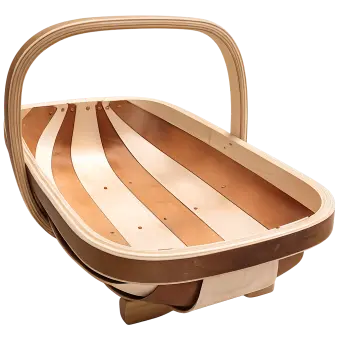
By pure fluke, both second and fifth boards were a shade darker than the rest. When the trug was finished, the alternating tones created a pattern — an effect I believed worth re-creating.
I decided to stain the second and fifth boards to create contrast. The result was impressive, but I thought perhaps too dramatic. So I experimented again, this time with a “Sunburst” effect: darker at each end, fading gently toward the centre. It felt right.
I was only twenty at the time, working for a company rather than for myself, but the design inexplicably reminded me of the word Harlequin. I took it to the director — a man not easily pleased — and to my surprise he loved it. He later sent it to the British Design Centre, where it was awarded their Design Centre badge for innovation.
Since then, others have copied the idea and nicknamed it the “Humbug Trug.” Perhaps a better name, but I don’t care, the story and the spark were mine.
In truth, it performs no differently from my classic trugs. After a year or two in the garden, the colours mellow and blend, as all wood eventually does. But as a gift, it has undeniable ‘WOW’ factor and has been used for garden produce competitions, by a restaurant chain for bread rolls, and even by the British Museum for displaying sandwiches in their restaurant - The Harlequin .
By pure fluke, both second and fifth boards were a shade darker than the rest. When the trug was finished, the alternating tones created a pattern — an effect I believed worth re-creating.
I decided to stain the second and fifth boards to create contrast. The result was impressive, but I thought perhaps too dramatic. So I experimented again, this time with a “Sunburst” effect: darker at each end, fading gently toward the centre. It felt right.
I was only twenty at the time, working for a company rather than for myself, but the design inexplicably reminded me of the word Harlequin. I took it to the director — a man not easily pleased — and to my surprise he loved it. He later sent it to the British Design Centre, where it was awarded their Design Centre badge for innovation.
Since then, others have copied the idea and nicknamed it the “Humbug Trug.” Perhaps a better name, but I don’t care, the story and the spark were mine.
In truth, it performs no differently from my classic trugs. After a year or two in the garden, the colours mellow and blend, as all wood eventually does. But as a gift, it has undeniable ‘WOW’ factor and has been used for garden produce competitions, by a restaurant chain for bread rolls, and even by the British Museum for displaying sandwiches in their restaurant - The Harlequin .
Trug Makers Harlequin Design
Every type of wood has its own character, grain, tone, and shades vary naturally, and for most trug makers that’s simply part of the material. But in 1970, while boarding a trug, a small of nature sparked something entirely new.
By pure fluke, both second and fifth boards were a shade darker than the rest. When the trug was finished, the alternating tones created a pattern — an effect I believed worth re-creating.
I decided to stain the second and fifth boards to create contrast. The result was impressive, but I thought perhaps too dramatic. So I experimented again, this time with a “Sunburst” effect: darker at each end, fading gently toward the centre. It felt right.
I was only twenty at the time, working for a company rather than for myself, but the design inexplicably reminded me of the word Harlequin. I took it to the director — a man not easily pleased — and to my surprise he loved it. He later sent it to the British Design Centre, where it was awarded their Design Centre badge for innovation.
Since then, others have copied the idea and nicknamed it the “Humbug Trug.” Perhaps a better name, but I don’t care, the story and the spark were mine.
In truth, it performs no differently from my classic trugs. After a year or two in the garden, the colours mellow and blend, as all wood eventually does. But as a gift, it has undeniable ‘WOW’ factor and has been used for garden produce competitions, by a restaurant chain for bread rolls, and even by the British Museum for displaying sandwiches in their restaurant - The Harlequin .
By pure fluke, both second and fifth boards were a shade darker than the rest. When the trug was finished, the alternating tones created a pattern — an effect I believed worth re-creating.
I decided to stain the second and fifth boards to create contrast. The result was impressive, but I thought perhaps too dramatic. So I experimented again, this time with a “Sunburst” effect: darker at each end, fading gently toward the centre. It felt right.
I was only twenty at the time, working for a company rather than for myself, but the design inexplicably reminded me of the word Harlequin. I took it to the director — a man not easily pleased — and to my surprise he loved it. He later sent it to the British Design Centre, where it was awarded their Design Centre badge for innovation.
Since then, others have copied the idea and nicknamed it the “Humbug Trug.” Perhaps a better name, but I don’t care, the story and the spark were mine.
In truth, it performs no differently from my classic trugs. After a year or two in the garden, the colours mellow and blend, as all wood eventually does. But as a gift, it has undeniable ‘WOW’ factor and has been used for garden produce competitions, by a restaurant chain for bread rolls, and even by the British Museum for displaying sandwiches in their restaurant - The Harlequin .

Trug Makers Harlequin Design
Every type of wood has its own character, grain, tone, and shades vary naturally, and for most trug makers that’s simply part of the material. But in 1970, while boarding a trug, a small of nature sparked something entirely new.
By pure fluke, both second and fifth boards were a shade darker than the rest. When the trug was finished, the alternating tones created a pattern — an effect I believed worth re-creating.
I decided to stain the second and fifth boards to create contrast. The result was impressive, but I thought perhaps too dramatic. So I experimented again, this time with a “Sunburst” effect: darker at each end, fading gently toward the centre. It felt right.
I was only twenty at the time, working for a company rather than for myself, but the design inexplicably reminded me of the word Harlequin. I took it to the director — a man not easily pleased — and to my surprise he loved it. He later sent it to the British Design Centre, where it was awarded their Design Centre badge for innovation.
Since then, others have copied the idea and nicknamed it the “Humbug Trug.” Perhaps a better name, but I don’t care, the story and the spark were mine.
In truth, it performs no differently from my classic trugs. After a year or two in the garden, the colours mellow and blend, as all wood eventually does. But as a gift, it has undeniable ‘WOW’ factor and has been used for garden produce competitions, by a restaurant chain for bread rolls, and even by the British Museum for displaying sandwiches in their restaurant - The Harlequin .
By pure fluke, both second and fifth boards were a shade darker than the rest. When the trug was finished, the alternating tones created a pattern — an effect I believed worth re-creating.
I decided to stain the second and fifth boards to create contrast. The result was impressive, but I thought perhaps too dramatic. So I experimented again, this time with a “Sunburst” effect: darker at each end, fading gently toward the centre. It felt right.
I was only twenty at the time, working for a company rather than for myself, but the design inexplicably reminded me of the word Harlequin. I took it to the director — a man not easily pleased — and to my surprise he loved it. He later sent it to the British Design Centre, where it was awarded their Design Centre badge for innovation.
Since then, others have copied the idea and nicknamed it the “Humbug Trug.” Perhaps a better name, but I don’t care, the story and the spark were mine.
In truth, it performs no differently from my classic trugs. After a year or two in the garden, the colours mellow and blend, as all wood eventually does. But as a gift, it has undeniable ‘WOW’ factor and has been used for garden produce competitions, by a restaurant chain for bread rolls, and even by the British Museum for displaying sandwiches in their restaurant - The Harlequin .
Trug Makers Harlequin Design
Every type of wood has its own character, grain, tone, and shades vary naturally, and for most trug makers that’s simply part of the material. But in 1970, while boarding a trug, a small of nature sparked something entirely new.
By pure fluke, both second and fifth boards were a shade darker than the rest. When the trug was finished, the alternating tones created a pattern — an effect I believed worth re-creating.
I decided to stain the second and fifth boards to create contrast. The result was impressive, but I thought perhaps too dramatic. So I experimented again, this time with a “Sunburst” effect: darker at each end, fading gently toward the centre. It felt right.
I was only twenty at the time, working for a company rather than for myself, but the design inexplicably reminded me of the word Harlequin. I took it to the director — a man not easily pleased — and to my surprise he loved it. He later sent it to the British Design Centre, where it was awarded their Design Centre badge for innovation.
Since then, others have copied the idea and nicknamed it the “Humbug Trug.” Perhaps a better name, but I don’t care, the story and the spark were mine.
In truth, it performs no differently from my classic trugs. After a year or two in the garden, the colours mellow and blend, as all wood eventually does. But as a gift, it has undeniable ‘WOW’ factor and has been used for garden produce competitions, by a restaurant chain for bread rolls, and even by the British Museum for displaying sandwiches in their restaurant - The Harlequin .
By pure fluke, both second and fifth boards were a shade darker than the rest. When the trug was finished, the alternating tones created a pattern — an effect I believed worth re-creating.
I decided to stain the second and fifth boards to create contrast. The result was impressive, but I thought perhaps too dramatic. So I experimented again, this time with a “Sunburst” effect: darker at each end, fading gently toward the centre. It felt right.
I was only twenty at the time, working for a company rather than for myself, but the design inexplicably reminded me of the word Harlequin. I took it to the director — a man not easily pleased — and to my surprise he loved it. He later sent it to the British Design Centre, where it was awarded their Design Centre badge for innovation.
Since then, others have copied the idea and nicknamed it the “Humbug Trug.” Perhaps a better name, but I don’t care, the story and the spark were mine.
In truth, it performs no differently from my classic trugs. After a year or two in the garden, the colours mellow and blend, as all wood eventually does. But as a gift, it has undeniable ‘WOW’ factor and has been used for garden produce competitions, by a restaurant chain for bread rolls, and even by the British Museum for displaying sandwiches in their restaurant - The Harlequin .